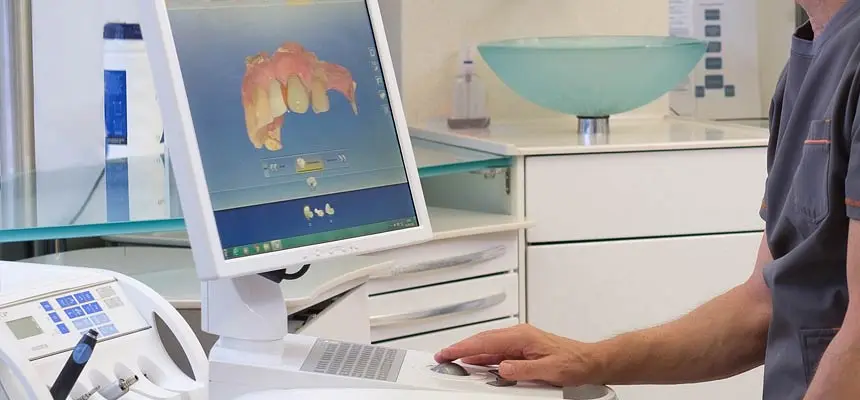
Cerec 3D
What does Cerec stand for?
CEramic REstoration Construction
What is Cerec 3D?
Tooth coloured CAD CAM (computer aided design – computer aided manufacture) restorations.
Using a small “camera” to take an optical impression of your tooth or cavity, we can now
design the new restoration on the computer,
cut it out of a solid block of matching porcelain and fit it in the same visit.
With the advantages of
final restoration in one visit
that means only one anaesthetic, no temporary, reduced need for putty impressions and tooth coloured ceramic restoration.
This technique can be used to provide white fillings, inlays, onlays, crowns, and veneers which are both aesthetically pleasing and have a proven prognosis.
With increasing computer sophistication we can now use a miniature infrared camera to take images of your teeth and design and manufacture your restorations in one visit.
Cerec 3D has been developed over the last 20 years and become part of our normal working day's practice.
As the first practice in Ireland to offer this facility and with the International Trainers Certificate we are able to offer this service as part of our normal working day.
Restoration of either an old filling or a new filling presents the dentist and patient with choices and decisions. Nowadays we still have the choice of amalgam (silver / mercury), composite (glass filler and paste), gold fillings or porcelain.
Although we offer all the above materials, increasingly we look to advantages of porcelain restorations fabricated using the Cerec 3D system.

These have many advantages
- The procelain is bonded to the tooth structure. This allows for a conservative preparation preserving as much tooth structure as possible.
- The material can be matched to the tooth colour and has a natural translucency that mimics enamel.
- It has wear characteristics similar to natural enamel. It will not have adverse effects on the opposing teeth and will age at a similar rate as the tooth around it.
- It can be completed usually in one visit.
- One anaesthetic.
- No temporary restoration required.
- No impressions.
- High polish and material stability, with good gum health.
- Long term monitoring. X-rays will pass through the porcelain but the cement will show up as a bright line. This can easily be monitored at later check ups.
Michelle was having sensitivity from the old amalgams present on two upper molars. The existing amalgams had been there 15 years. At one visit we removed the old amalgam (1) to discover the decay present under the old fillings (2)

The soft decay was removed to give hard clean tooth and the thin weakened enamel was carefully shaped and polished. (3) This cavity was then scanned with an infra-red camera and the restoration designed with the Cad Cam software.
The designed porcelain inlay can then be milled from a solid porcelain block to match the colour of the natural surrounding teeth.

The final restorations are bonded into place with a tooth coloured cement. These inlays are designed to have similar optical properties as enamel, they wear at a similar rate to enamel, and have a survival rate of 95% over 15 years.
